How Much Does Dental Bonding Cost in Nashville?
The short answer for most bonding repairs (chips, cracks, gaps, reshaping): $240 to $475 per tooth. Composite veneers, which cover the entire front of a tooth to mask stains or discoloration, run higher: $660 to $1,015 per tooth. The final number depends on how many surfaces of the tooth are involved and what type of repair you need.
Here’s the teeth bonding cost breakdown by repair type:
| Repair Type | Cost Range |
|---|---|
| Small chip repair (one or two surfaces, anterior composite filling) | $240 - $305 |
| Moderate chip or crack (three or more surfaces, or involving the incisal angle) | $350 - $415 |
| Gap closure or diastema (per tooth) | $300 - $415 |
| Tooth reshaping (odontoplasty, per tooth) | $150 - $300 |
| Full tooth restoration (four or more surfaces, no incisal angle) | $415 - $475 |
| Composite veneer (full front-of-tooth coverage for stain or discoloration) | $660 - $1,015 |
Most bonding cases involve one to three teeth. A single small chip repair might run $240 (our chipped tooth repair guide covers every repair option by chip size). Closing a gap between two front teeth (bonding both sides) often lands at $600-$800 total. Bonding also handles craze lines, peg lateral teeth, and translucent edges, each covered in its own guide. These are Nashville-area averages, and which repair your tooth actually needs is something your dentist will diagnose at the visit.
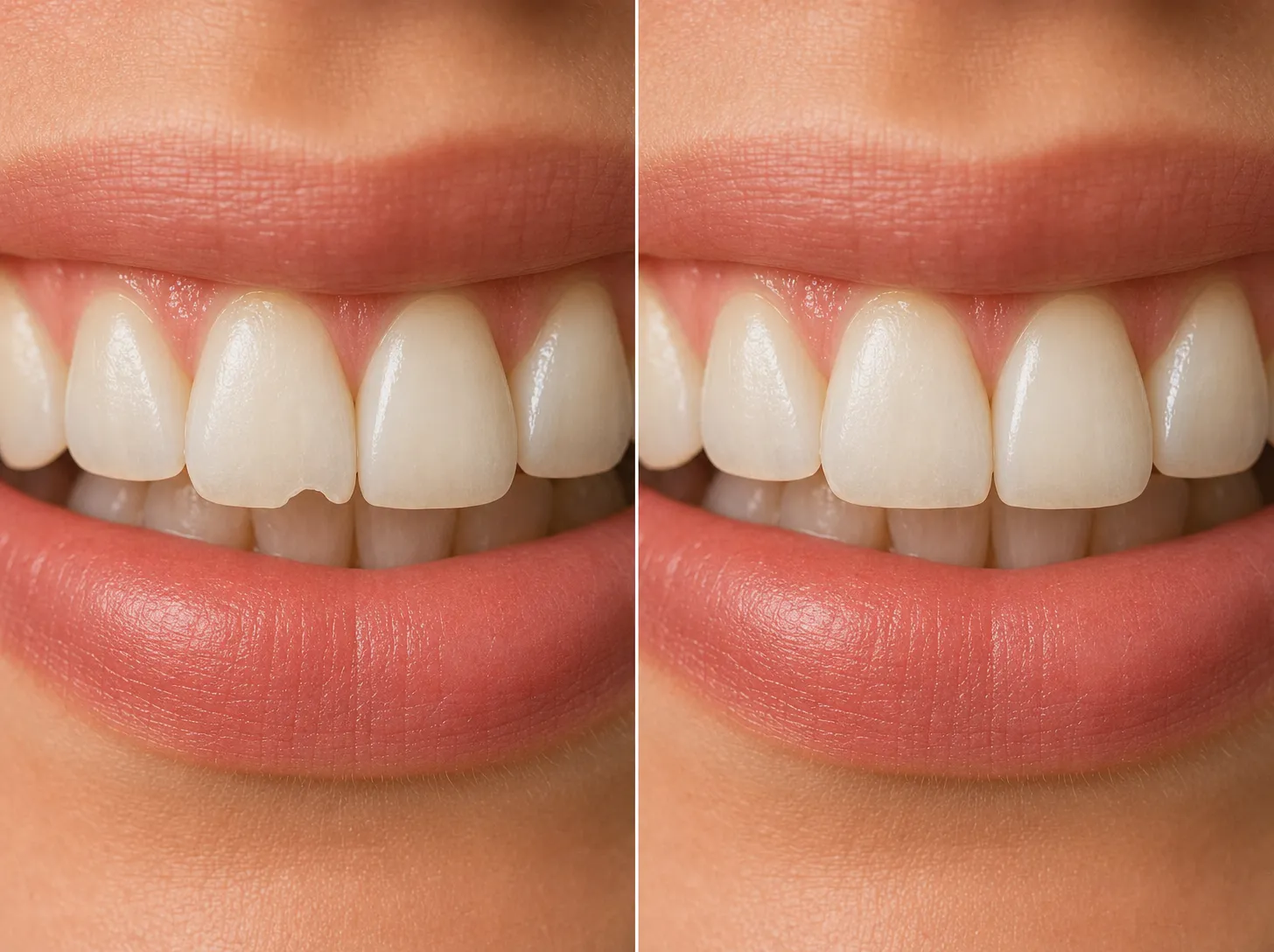
Representative image, not an actual patient photo.
Composite Bonding vs. Dental Bonding
Searches for “composite bonding cost” and “dental bonding cost” turn up different results, but they’re the same procedure.
Both terms describe applying tooth-colored composite resin directly to your teeth: repairing chips, closing gaps, covering stains, or reshaping. Some dentists call it “composite bonding” to specify the material. Others call it “dental bonding” or “teeth bonding.” The procedure is the same either way.
The one term that means something different is “dental adhesive bonding,” a lab technique for attaching veneers or crowns. That’s not what we’re covering here.
Bottom line: if you’re comparing quotes and one office says “composite bonding” while another says “dental bonding,” they’re offering the same treatment at the same composite bonding price.
What Affects Your Teeth Bonding Cost?
A chip on a back molar and a chip on a front tooth can look identical and price out differently. The factors that drive your bill:
Size and Complexity of the Repair
A tiny chip on a front tooth is straightforward. Minimal resin, minimal shaping, done in 20 minutes. A larger chip that wraps around the tooth edge, or a gap that requires building up both adjacent teeth, takes more material, more skill, and more chair time. Complexity is the single biggest cost driver.
Number of Teeth
More teeth means more chair time. Some offices offer a slight discount when bonding multiple teeth in one visit since the setup and preparation overlap. Ask about multi-tooth pricing during your consultation.
Tooth Location
Front teeth are visible and demand precise color matching and artistic shaping. Back teeth (when bonding is appropriate) are more functional and less cosmetically demanding. Front-tooth bonding typically costs more because the aesthetics matter more.
Material Quality
Composite resins range from standard to premium. Higher-end composites hold their color, mimic natural translucency, and keep their polish longer. The material cost difference is modest, and the results over 5-10 years are noticeable. Ask which composite an office uses before you compare quotes.
Provider Experience
Bonding is as much art as science. A dentist with cosmetic experience will produce results that blend with your natural teeth: the color match, the contour, the way light catches the surface. Less experienced providers may charge less, but the difference shows. Front-tooth bonding is visible every time you smile, and that’s not where you want to cut corners.
Geographic Location
Nashville dental costs fall mid-range nationally. Downtown and Gulch practices charge more due to overhead. Suburban offices in the Nashville metro run about the same. Rural Tennessee costs less, but traveling for cheaper bonding means traveling for every touch-up and adjustment too. Bonding does need occasional maintenance.
Does Insurance Cover Dental Bonding?
It depends on why you’re getting it done.
Functional vs. Cosmetic
Most dental insurance plans split bonding into two categories:
- Functional/restorative bonding. Repairing a chipped or cracked tooth, or filling a cavity with composite resin. Insurance often covers this as a basic or major restorative procedure, though coverage varies widely by plan and some plans cover a lot less than others.
- Cosmetic bonding. Closing a gap, covering stains, reshaping a tooth for appearance. Insurance usually does not cover purely cosmetic work.
The line isn’t always clear. A chipped tooth that’s also cosmetically improved can qualify for partial coverage. How your dentist documents the procedure matters.
Typical Insurance Coverage for Dental Bonding
If your bonding qualifies as restorative:
- Coverage rate. Varies widely by plan. Some cover a meaningful portion of restorative work, others much less.
- Annual maximum. Often $1,000 to $2,500. Bonding fits within this for most patients.
- Waiting period. Some plans require 6-12 months before covering major procedures.
How to Maximize Your Insurance Benefits
-
Call your insurer and ask about your benefits. Coverage rates and exclusions vary plan to plan. Knowing what your plan does and doesn’t cover before treatment helps you plan.
-
Frame it as restorative when accurate. A chipped tooth is a structural issue, not just cosmetic. Proper coding makes the difference between $0 coverage and a meaningful chunk paid by insurance.
-
Use your annual maximum. If your plan year resets soon, schedule bonding now so it falls within the current benefit period.
-
Check your HSA/FSA. Dental bonding qualifies for pre-tax health savings dollars. At a 25% tax bracket, $300 in bonding costs you $225 in real dollars.
Example: What You’d Pay for Composite Bonding
A realistic Nashville scenario for bonding two front teeth, assuming a plan that covers 60% of restorative work:
- Two-tooth composite bonding: $650
- Insurance pays (restorative, 60%): -$390
- Your out-of-pocket: $260
Actual numbers depend on your plan. Some pay more, some pay less, and purely cosmetic bonding is usually not covered at all.
For purely cosmetic bonding (insurance doesn’t cover):
- Two-tooth composite bonding: $650
- Insurance: $0
- Your out-of-pocket: $650
Ask any office for a written benefits check before treatment starts, so the out-of-pocket number is settled up front.
Financing Options
Bonding is already one of the cheapest cosmetic options, but a few tools make the out-of-pocket number even smaller:
Sunbit Financing
Many Nashville practices use Sunbit for patient financing. Approval takes minutes, plans start around $25 per month, and qualified patients get 0% APR.
HSA/FSA Accounts
Dental bonding qualifies as a medical expense. Pay with pre-tax dollars and save 20-30%, depending on your tax bracket.
FSA tip: These funds expire annually. If your plan year is ending, use FSA dollars for bonding before you lose them.
In-House Payment Plans
Many dental offices offer interest-free plans for smaller procedures. Since the total teeth bonding cost runs $240-$950 for most one- to two-tooth cases, the monthly payments stay manageable.
Dental Bonding Cost vs. Veneers, Crowns, and Whitening
Bonding isn’t the only option for chips, gaps, and discoloration. Here’s how the cost compares. For a full breakdown of the veneer side of this decision, see our porcelain veneers cost guide.
| Option | Cost Per Tooth | Lifespan | Reversible? | Visits |
|---|---|---|---|---|
| Composite bonding | $240 - $475 | 5-10 years | Yes | 1 |
| Porcelain veneers | $1,800+ | 10-15 years | No | 2-3 |
| Dental crowns | $1,400 - $1,800 | 10-15 years | No | 2 |
| Teeth whitening | $550 | 6-12 months | N/A | 1-2 |
10-Year Cost Comparison (Per Tooth)
| Option | Upfront | Replacements | 10-Year Total |
|---|---|---|---|
| Composite bonding | $325 | 1 replacement ($325) | $650 |
| Porcelain veneers | $1,800+ | None (lasts 10-15 yrs) | $1,800+ |
| Dental crown | $1,600 | None (lasts 10-15 yrs) | $1,600 |
Composite bonding costs less upfront and over 10 years for most repairs. The trade-off: veneers and crowns resist staining better, take more abuse, and last longer before replacement.
When Bonding Makes the Most Sense
- Budget is a factor. Teeth bonding costs a fraction of what veneers cost.
- The repair is small. Chips, minor gaps, surface stains. Bonding handles these.
- You want reversibility. Bonding doesn’t remove enamel. Veneers do.
- You want it done today. One appointment, same-day results.
- You’re testing cosmetic work. Try bonding before committing to porcelain veneers.
When to Consider Alternatives
- You want permanent results. Veneers and crowns last 10-15+ years without replacement.
- The damage is extensive. Large chips, broken cusps, or structural damage often need crowns (see dental crowns in Nashville for pricing).
- Stain resistance matters. Porcelain resists staining better than composite over time.
- Multiple teeth need a full makeover. A set of veneers across your smile line produces more uniform, dramatic results than bonding several teeth individually. Our guide to the best cosmetic dentistry options in Nashville walks through how those plans get sequenced.
Is Dental Bonding Worth the Cost?
For most cosmetic repairs, yes.
You’re paying $240-$475 to fix a cosmetic issue in one appointment. Usually no drilling, no anesthesia, and no recovery time. The result lasts 5-10 years, and if it chips or wears, a dentist can replace it in about 30 minutes. Your natural tooth stays untouched underneath.
Compare that to veneers: $1,800+ per tooth, two appointments, permanent enamel removal, and a wait for the lab. Veneers last longer and resist staining better, though for a single chip or small gap the cost difference is hard to justify.
Bonding suits patients who want a visible improvement without a large financial commitment. Because it’s reversible, there’s little risk in trying it first.
How to Save on Your Composite Bonding Cost
1. Get Multiple Teeth Done at Once
If you need bonding on several teeth, schedule them in one visit. The setup, shade matching, and any anesthesia happen once, and many offices offer a per-tooth discount for multi-tooth cases.
2. Use Pre-Tax Dollars
HSA and FSA accounts cut your effective cost by 20-30%. A $350 bonding procedure costs $245 in real after-tax dollars at a 30% bracket.
3. Ask About Restorative Coding
If your bonding repairs structural damage (not just cosmetic), make sure it’s coded as restorative for insurance. The difference between “cosmetic” and “restorative” coding can mean the difference between $0 coverage and a meaningful chunk paid by insurance.
4. Maintain Your Bonding
Daily care stretches bonding life from 5 years to 10+. Avoid biting hard objects, don’t use bonded teeth as tools, and keep up with cleanings. Prevention costs less than replacement.
5. Choose an Experienced Provider
This sounds counterintuitive for saving money, but well-done bonding lasts longer and looks better. Cheap bonding that chips in 2 years costs more long-term than quality work that lasts 8-10.
FAQs About Dental Bonding Cost
How much does it cost to bond one tooth?
$240 to $475 per tooth at most Nashville dental offices for bonding repair, depending on the size and number of surfaces involved. A small one- or two-surface chip repair runs $240-$305. Gap or diastema closure runs $300-$415. Tooth reshaping (odontoplasty) runs $150-$300. A larger restoration involving three or more surfaces (or the incisal angle) runs $350-$415. A composite veneer that covers the entire front of the tooth runs higher, $660-$1,015. Your dentist diagnoses which repair fits your tooth at the exam.
Is dental bonding cheaper than veneers?
By a wide margin. Bonding costs $240-$475 per tooth vs. $1,800+ for porcelain veneers. Bonding finishes in one visit. Veneers need 2-3 appointments. The trade-off is longevity: veneers last 10-15 years vs. 5-10 for bonding. Our porcelain veneers cost guide breaks down when the higher veneer price is worth it.
Does composite bonding look natural?
When done well, yes. Modern composite resins come in dozens of shades and translucencies that match natural teeth. An experienced dentist layers and shapes the resin to blend with your surrounding teeth. On front teeth, skilled bonding is hard to spot, even for other dentists.
How long does the bonding procedure take?
30-60 minutes per tooth. Most patients need bonding on 1-3 teeth, so a typical appointment runs 30 minutes to 2 hours. Anesthesia is rarely needed, and there’s zero recovery time.
Can dental bonding fix crooked teeth?
Bonding can make mildly crooked teeth look straighter by building up thin areas and reshaping contours. It doesn’t move teeth. For significant misalignment, orthodontics is the right approach. But for minor irregularities, bonding creates the illusion of straighter teeth at a fraction of the orthodontic cost.
Can dental bonding close black triangles between teeth?
Yes, and it’s one of the most common reasons people ask about bonding. Black triangles (the small spaces at the gumline between teeth) close with composite bonding or the Bioclear method, which is a specialized matrix technique built for this exact problem. Pricing is per “site” (the contact between two teeth) rather than per tooth. See our black triangles treatment guide for causes, treatment options, and Nashville pricing.
Does dental bonding break easily?
Composite resin handles normal use well but isn’t indestructible. Bonding can chip if you bite hard objects (ice, pen caps, fingernails) or use your teeth as tools. With normal eating and decent habits, bonding holds up for 5-10 years. If it does chip, repairs are quick and affordable, usually 15-20 minutes.
Can I eat after dental bonding?
Yes, right away. The curing light hardens the resin completely during the appointment, so there’s no waiting period. Going easy on hard or crunchy foods for the first 24 hours is a good idea while the bond reaches full strength, but normal meals are fine immediately.
Is composite bonding worth it for front teeth?
Front teeth are where bonding shines. The procedure is quick, painless, and produces results you’ll notice every time you smile. For small chips, minor gaps, or discoloration on front teeth, the composite bonding cost delivers the best value of any cosmetic dentistry option.
Next Steps
A bonding consultation with Dr. D’Aoust takes about 30 minutes: an exam of the teeth you want fixed, the repair type your tooth needs, your insurance verified, and your exact price before any work starts. Patients come from across West Nashville, Sylvan Park, and the surrounding metro.
Book your first visit online or call (615) 933-5800. You can also contact us with questions.