What Is a Peg Lateral Tooth?
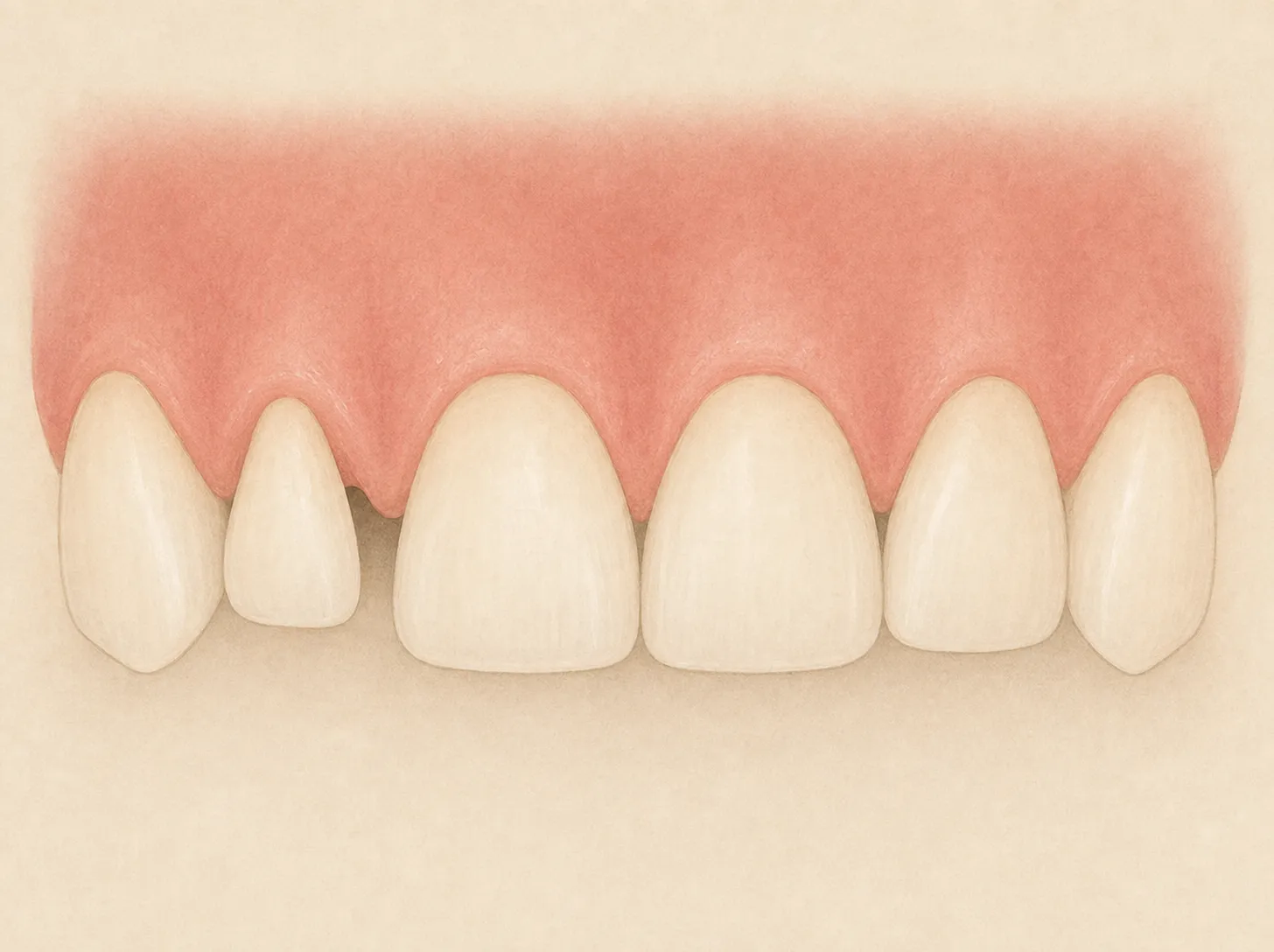
Your upper lateral incisors sit between your two front teeth (the centrals) and your canines. A normal lateral incisor is roughly rectangular, close in shape to the central next to it, just slightly smaller.
A peg lateral tooth didn’t develop to that full shape. It comes in narrow and tapered, wider at the gumline and pointed at the biting edge, like a small cone. Dentists sometimes call this a peg-shaped tooth or peg tooth. Patients often call them peg teeth. It’s a shape and size issue rather than a health issue. The tooth is fully formed and functional, just smaller and a different shape than the tooth beside it.
Peg laterals are present from the time the permanent tooth erupts, usually around age 8 to 10. Nothing changes it over time. The tooth that comes in peg-shaped stays peg-shaped unless it’s treated.
Small teeth more broadly, including gummy smiles and worn teeth that only look small, are covered in this guide to microdontia and small teeth. This article goes deeper on peg laterals, which are the most common version of the problem by a wide margin.
What Causes Peg Lateral Teeth?
Genetics is the main cause. Peg laterals run in families the same way tooth size, jaw shape, and spacing do. If a parent or sibling has a peg lateral, there’s a real chance it shows up in the next generation too.
A few other patterns show up alongside peg laterals:
- One-sided vs. two-sided. Most patients have a peg lateral on one side only, with a normal-shaped lateral on the other. Both sides being affected happens too, just less often.
- Missing lateral on the other side. Sometimes the lateral incisor on the opposite side never develops at all, a condition called congenitally missing lateral incisors. When one lateral is a peg and the other is missing, or both laterals are missing, that’s part of the same genetic pattern rather than a coincidence.
- No outside cause. Peg laterals aren’t caused by anything a parent did or didn’t do during pregnancy or childhood. They’re a developmental trait, and they don’t come from an injury, illness, or medication.
Peg laterals show up in roughly 1 to 2 percent of people, which makes them the most common form of localized microdontia.
Are Peg Laterals a Problem?
For most patients, no. A peg lateral bites and chews normally. It’s not painful, and its shape alone doesn’t raise the risk of decay or gum disease.
The issues that come up are cosmetic and, sometimes, related to spacing:
- Visible gaps. Because a peg lateral is narrower than a normal lateral, there’s often extra space on one or both sides of it. That space shows up as a gap next to the peg tooth, or between the front two teeth if the peg lateral’s neighbors shift to fill some of the space.
- Food and hygiene. Larger gaps around a peg lateral can trap food, which means a bit more attention to flossing in that area.
- Asymmetry. Because the peg lateral is usually smaller than the tooth on the opposite side, the smile can look uneven, especially in photos.
- Drifting over time. If the gap around a peg lateral is large, the central incisor in front of it or the canine behind it can gradually tip or drift into the space. Left long enough, that shifts the bite as well as the look of the smile.
If your peg lateral isn’t bothering you and your bite feels normal, there’s no urgency to treat it. Most patients treat a peg lateral because they want it to match the rest of the smile, not because of pain or dysfunction.
Treatment Options for Peg Lateral Teeth
Composite Bonding
For most peg laterals, composite bonding is the first option to consider, and it’s one of the best cases for bonding that exists. Tooth-colored composite resin goes on the sides and edge of the tooth and builds it out to match the width, length, and shape of the lateral incisor on the other side. No enamel removal, one visit, and the result is visible the same day.
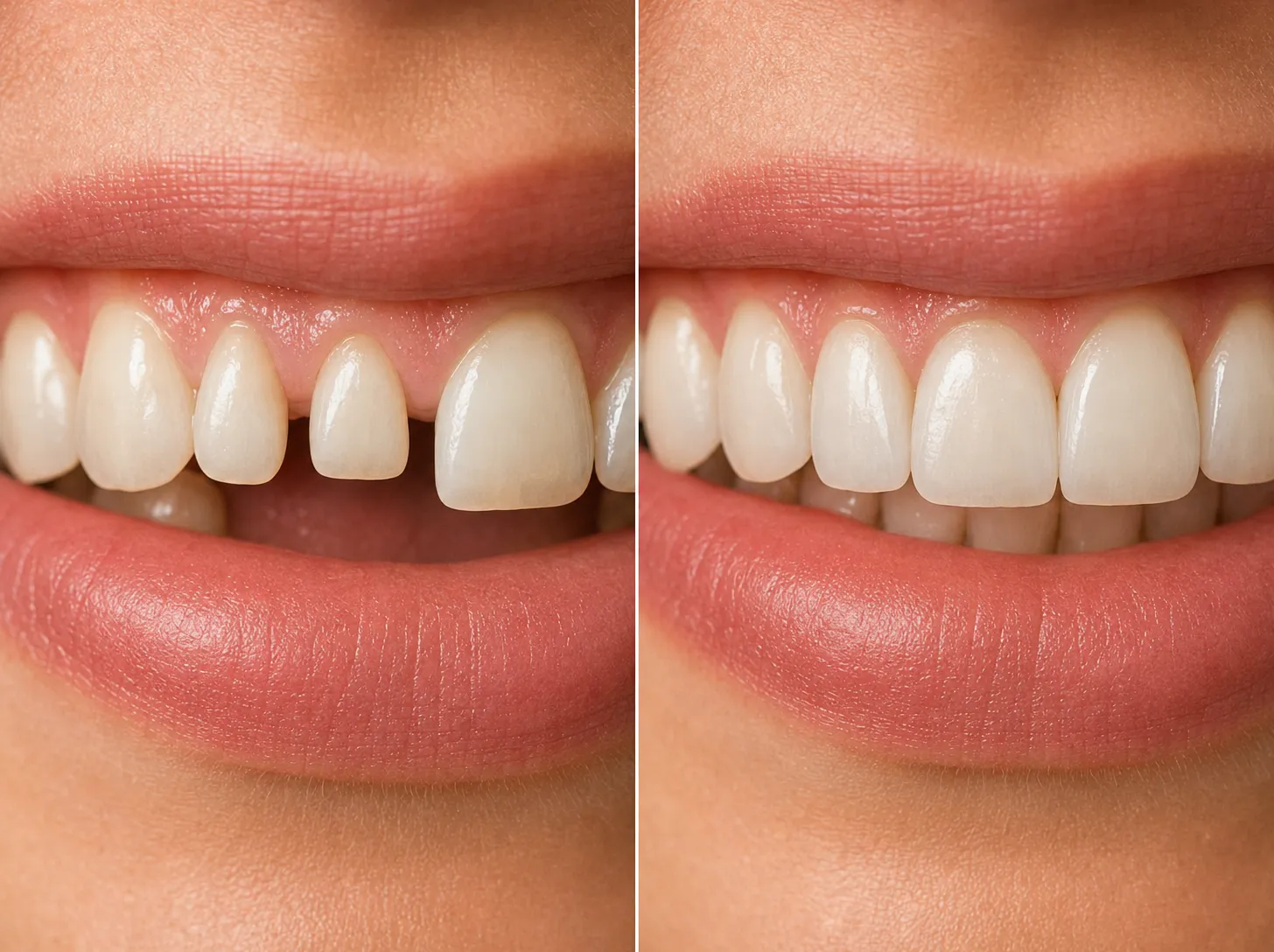
Representative image, not an actual patient photo.
Peg laterals respond well to bonding because the underlying tooth structure is healthy. There’s no decay or damage to work around, just shape to add. That makes the case predictable and the result durable for a conservative, reversible treatment.
Cost: $240 to $475 per tooth, depending on how much shape needs to be built and how many surfaces are involved. This dental bonding cost guide breaks down how bonding is priced in more detail.
Composite Veneer
If the peg lateral needs a fuller rebuild across the whole front surface rather than added width at the edges, a composite veneer gives more complete coverage while staying in the same material family as bonding.
Cost: $660 to $1,015 per tooth.
Porcelain Veneer
For the most durable, stain-resistant, and lifelike result, or when a peg lateral is being treated alongside other cosmetic goals like color or overall smile shape, a porcelain veneer is the longer-lasting option. A custom-made porcelain shell replaces the front surface of the tooth and is shaped to match the width, length, and translucency of the tooth beside it.
Cost: $1,800+ per tooth. Porcelain veneers require removing a thin layer of enamel and take two to three visits, so they’re a bigger commitment than bonding. For a single peg lateral, bonding often gets you most of the way there. Porcelain is worth it when you want the most durable result, or when you’re addressing more than the one tooth.
When Orthodontics Comes First
If the gap around a peg lateral is large, or the teeth have shifted to partly fill the space, building the tooth up with bonding or a veneer right away can leave it looking crowded or oddly positioned. In these cases, Invisalign moves the teeth into better position first and redistributes the space evenly, so the peg lateral and its neighbors end up with the right amount of room before any restorative work happens.
This combination comes up often with peg laterals, since the gap pattern is so common. Aligning first also means less bonding material is needed afterward, which tends to give a cleaner final result. Closing space near the gumline can also leave black triangles between the teeth, which the same bonding appointment can address.
Cost: $5,000 for a full Invisalign case, all-inclusive. That’s worth it if you have other spacing or alignment concerns beyond the one tooth. This Invisalign cost guide has more on how Invisalign pricing works.
Treatment Comparison
| Treatment | Visits | Best for |
|---|---|---|
| Composite bonding | 1 | Most peg lateral cases |
| Composite veneer | 1-2 | Fuller rebuild of the tooth |
| Porcelain veneer | 2-3 | Most durable result, or treating multiple cosmetic goals at once |
| Invisalign, then bonding/veneer | Months, then 1-3 | Large gaps or shifted teeth around the peg lateral |
Peg Laterals in Teens vs. Adults
Peg laterals are usually spotted the moment the permanent lateral incisors come in, around age 8 to 10. Parents often ask whether to fix it right away.
In most cases, waiting is better. Teeth and gums are still settling into their final position through the early teenage years, and if orthodontic treatment is in the plan, that should finish first. Bonding a peg lateral before braces or Invisalign is done means redoing the work once the tooth’s neighbors have moved. The general pattern is to finish orthodontics, let the gum tissue mature around the newly positioned teeth, then do the final bonding or veneer.
Adults with a peg lateral they’ve had since childhood can treat it at any age. There’s no downside to waiting years to address it, and no advantage to rushing. Bonding, composite veneers, and porcelain veneers all work the same way regardless of when you get around to it.
What to Expect: Before and After
The most common before-and-after with a peg lateral involves three changes at once: the tooth gets wider, the tooth gets a squared-off edge instead of a point, and the gap next to it closes or shrinks. Because the change happens on one tooth, matched to the shape and shade of the tooth on the opposite side, the result reads as a normal, symmetrical smile rather than an obviously worked-on tooth.
Patients are often surprised by how much a single tooth affects the whole smile. Once a peg lateral matches its neighbor in width and shape, the eye stops catching on the asymmetry, even in close-up photos.
How Much Does Peg Lateral Treatment Cost in Nashville?
For most patients, bonding a single peg lateral runs $240 to $475 and is finished in one visit. That’s the most common and most affordable fix for this concern.
For a longer-lasting, more stain-resistant result, or when other cosmetic concerns are being treated at the same time, porcelain veneers start at $1,800 per tooth. Composite veneers sit in between at $660 to $1,015 for a fuller rebuild than bonding without the cost of porcelain.
If the case needs orthodontics first to create even spacing, Invisalign runs $5,000 all-inclusive, with bonding or a veneer to follow once the tooth is in its final position.
Does Insurance Cover Peg Lateral Treatment?
Usually not. Bonding or veneers to reshape a peg lateral are typically classified as cosmetic by dental insurance. A few exceptions:
- HSA and FSA funds can be used for bonding, composite veneers, or porcelain veneers
- If a peg lateral is part of a broader bite or functional issue, part of the orthodontic treatment may be covered
- Some plans partially cover pediatric cases when a peg lateral is documented as a developmental anomaly, though coverage varies widely
Financing Options
- Sunbit: Most patients get approved in minutes, with 0% APR for qualified applicants.
- HSA/FSA: Pre-tax dollars reduce your effective cost by 20-30%.
- In-house payment plans: Available for larger cases, including Invisalign plus bonding or veneers.
FAQs About Peg Lateral Teeth
What is a peg lateral tooth?
A peg lateral is an upper lateral incisor (the tooth next to your two front teeth) that developed small and cone-shaped instead of the normal rectangular shape. It’s present from childhood and doesn’t change on its own.
What causes peg lateral teeth?
Genetics is the main cause. Peg laterals run in families and are sometimes paired with a missing lateral incisor on the opposite side. There’s no outside cause, like an injury or illness, behind a typical peg lateral.
Are peg laterals rare?
Peg laterals show up in roughly 1 to 2 percent of people, which makes them the most common form of localized microdontia, meaning a tooth or teeth that develop smaller than normal.
How much does it cost to fix a peg lateral tooth?
Bonding for a single peg lateral runs $240 to $475 and is done in one visit. Composite veneers run $660 to $1,015 per tooth. Porcelain veneers start at $1,800 per tooth. If Invisalign is needed first to fix spacing, that runs $5,000, all-inclusive.
What does peg lateral teeth before and after look like?
The tooth typically gains width and a squared edge instead of a point, and the gap next to it closes or shrinks. Because the shade and shape are matched to the tooth on the opposite side, the result looks like a normal, symmetrical smile rather than an obviously treated tooth.
Do peg laterals need braces first?
Not always. If the gap around the peg lateral is small, bonding or a veneer alone can close it. If the gap is large or nearby teeth have already drifted, Invisalign first distributes the spacing evenly, then bonding or a veneer finishes the tooth.
Can a peg lateral be fixed without a veneer?
Yes. Composite bonding is a same-day, no-enamel-removal option that works well for most peg laterals. Veneers are for patients who want the most durable, stain-resistant result or who are treating additional cosmetic concerns at the same time.
Should I wait to treat my child’s peg lateral?
Usually, yes. Most dentists wait until any orthodontic treatment is finished and the gum tissue around the repositioned teeth has settled before doing the final bonding or veneer. Treating it too early often means redoing the work later.
Next Steps
A consultation with Dr. D’Aoust covers the measurement of the tooth, your options, and a specific quote before any work starts. You can also contact us with questions first.