What Are Black Triangles?
A black triangle (clinical name: open gingival embrasure) is the small triangular gap that appears between two teeth at the gumline. It’s not a gap between the teeth at the biting edge. It’s space where the gum tissue used to fill in but no longer does.
Healthy gums form a little pink peak between each pair of teeth. That peak is called the interdental papilla. When the papilla shrinks back or disappears, you’re left with a dark triangle showing the space behind it.
Most patients notice them first on the upper front teeth, because that’s where they’re visible when you smile. They’re also common between the lower front teeth, where gum recession tends to show up first. Either set of front teeth is where they bother people most.
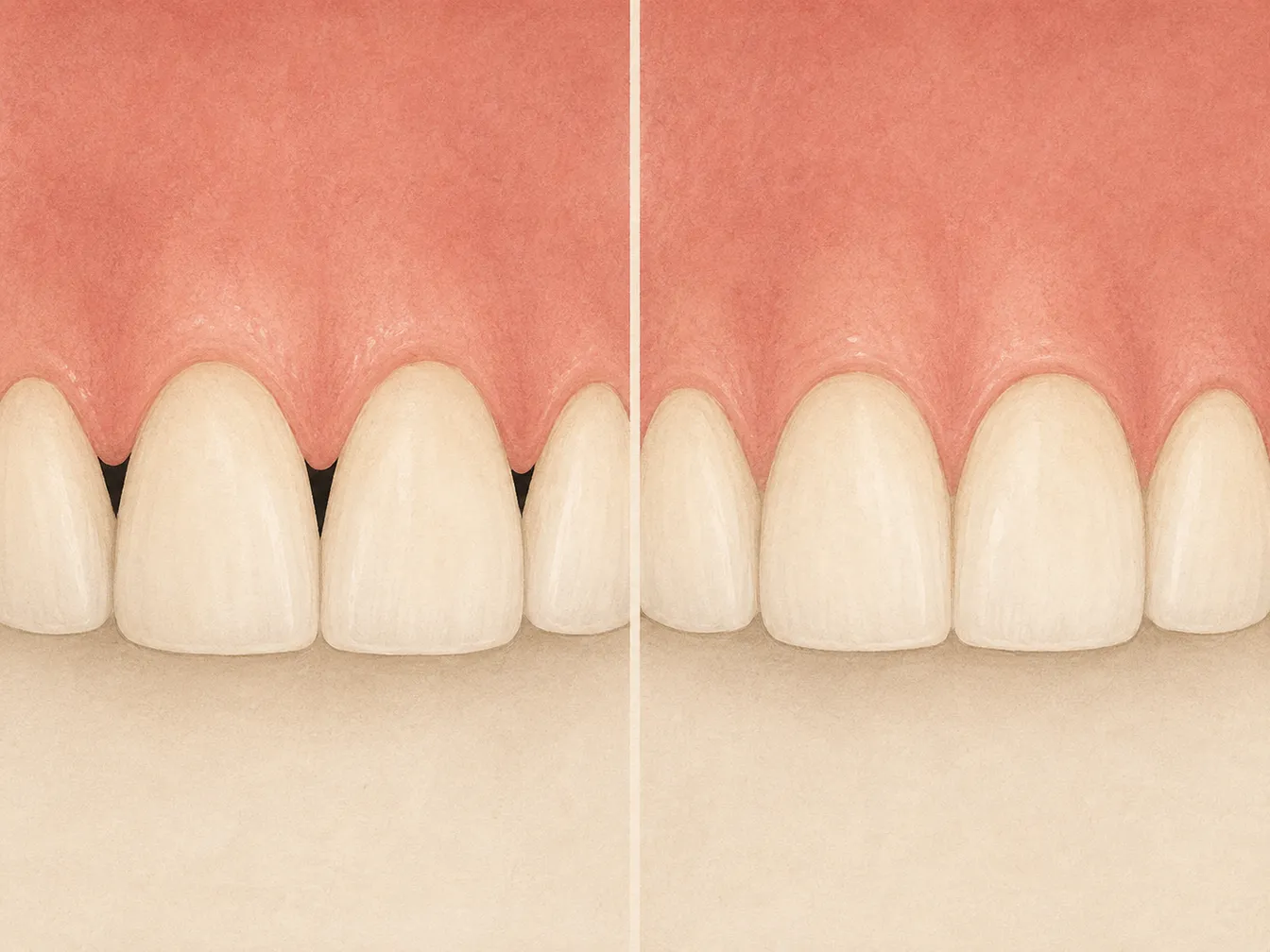
What Causes Black Triangles?
Black triangles aren’t a single problem. They show up for several different reasons, and the cause matters because it affects which treatment makes sense.
Gum Recession
The most common cause. Gum tissue pulls back over time, exposing more tooth and creating space where the papilla used to sit. Once the papilla recedes, it almost never grows back on its own.
After Braces or Invisalign
Orthodontic treatment moves teeth into better alignment, but it can change how teeth contact each other. Triangular-shaped teeth (especially upper laterals and centrals) are prone to this. When the teeth align, the contact point shifts up the tooth, leaving a triangle of space below it. Black triangles often appear in patients who just finished aligners and had none before treatment.
Bone Loss from Periodontal Disease
When bone supporting your teeth is lost to periodontal disease, the gum tissue follows the bone down. This is the cause to take seriously. Black triangles here are a symptom of something larger, and treatment starts with stabilizing the gums and the bone, not cosmetic work. If the bone problem isn’t addressed, the gum problem isn’t really fixed either.
Aggressive Brushing or Flossing
Years of hard-bristled brushing or whipping the floss too aggressively wears down delicate papilla tissue. Once it’s gone, it doesn’t return.
Tooth Shape
Some patients have naturally triangular teeth, where the crown is wider at the biting edge and narrower at the gumline. These teeth meet at a single point near the top, leaving a triangular space at the gumline by design. Nothing has gone wrong. The teeth are just shaped that way.
Age
Papilla volume shrinks with age. Even with good gum health, the small peaks of tissue lose volume in your 40s, 50s, and beyond.
Are Black Triangles Normal? Do They Mean Bone Loss?
Both questions come up constantly, so here’s the straight answer.
Are they normal? They’re common in adults, and in plenty of cases nothing is wrong. The cause matters more than the appearance.
Do they mean bone loss? Sometimes. If you have periodontal disease, the bone supporting your teeth is lost and the gum tissue follows it down. Plenty of patients have black triangles with healthy bone. The papilla can recede from gum-only causes (brushing trauma, age, or the way teeth contact each other after orthodontic treatment like braces or Invisalign) without any bone involvement.
The way to know which one you have is a periodontal exam with pocket depth measurements around each tooth and X-rays showing the bone level. That’s what separates a cosmetic issue from a periodontal one.
Can Black Triangles Be Fixed?
Yes. Several treatments work, and the right one depends on the cause, the size of the triangle, and how much you want to spend.
A black triangle is the loss of gum tissue (the papilla) in the space between two teeth. Once that tissue is gone, brushing differently, gum massage, or any home routine won’t bring it back. Closing the space means rebuilding the side walls of the teeth, repositioning the teeth, or in some cases addressing the underlying gum and bone health.
Which approach fits a given case is something a dentist diagnoses at the exam. Whichever treatment you choose, the result depends heavily on home care: regular cleanings, daily flossing, and consistent hygiene are what keep the work looking good year after year.
Treatment Options for Black Triangles
1. Bioclear Method
Bioclear is a specialized composite bonding technique designed specifically for closing black triangles. It uses clear, anatomically shaped matrices that wrap around the tooth and extend below the gumline. Heated, injection-molded composite flows into the matrix and bonds the tooth into the new contour.
The result is a sealed, polished, anatomically correct contact between the teeth that closes the triangle from gumline to contact point.
Why it’s the usual first choice for black triangles:
- The matrices produce a smoother, more durable result than freehand composite
- The technique seals the gumline tightly, so food doesn’t pack into the area
- The smooth, polished contour is easier to keep clean and healthy long term
- One to two visits depending on how many sites
- Research supports 8-10+ year results, though longevity depends heavily on home care, hygiene habits, and regular cleanings
For a full breakdown of the technique and what it treats beyond black triangles, see the Bioclear service page. The same family of techniques also blends away white spots on teeth, another common cosmetic concern treated with resin infiltration.
2. Traditional Composite Bonding
Freehand composite bonding works for smaller black triangles or when budget is the main constraint. The dentist applies composite resin to the sides of both adjacent teeth and shapes it by hand to close the space.
It’s faster and less expensive than Bioclear. The results don’t hold up as long, though. Composite at the gumline picks up stain faster, and freehand contouring tends to leave small ledges that catch plaque.
For small triangles in low-visibility spots, this can be the right call. For larger or front-tooth triangles, Bioclear produces a better result. For a deeper look at how composite bonding is priced by surface count and case complexity, see our dental bonding cost guide.
3. Porcelain Veneers
Veneers work for patients who want a full smile redesign and have multiple cosmetic concerns beyond the black triangles. Custom-made porcelain shells cover the front of each tooth and can be shaped to close any spaces, including triangles.
The trade-off: veneers require permanent removal of a thin layer of enamel, take two to three visits, and cost significantly more. For black triangles alone, veneers are overkill. For black triangles plus discoloration, plus shape concerns, plus minor misalignment, they can solve everything at once.
Cost range: $1,800+ per tooth. Our porcelain veneers cost guide breaks down composite vs. porcelain and when veneers are worth it over bonding.
4. Orthodontics (Invisalign)
If black triangles came from misaligned teeth with triangular contact points high on the tooth, Invisalign can sometimes reposition the teeth so the contact moves lower. That reduces or closes the triangle without adding any material.
One catch: Invisalign doesn’t grow gum tissue back. If the papilla has receded, orthodontics alone won’t fill the space. If the triangle is from the way teeth contact each other after misalignment, aligning them differently can solve it.
Cost: $5,000 for a full, all-inclusive Invisalign case at our practice. Worth considering when there are other alignment concerns too. Our Invisalign cost guide covers Nashville pricing, insurance, and financing in detail.
Treatment Comparison
| Treatment | Visits | Best for |
|---|---|---|
| Bioclear method | 1-2 | Most black triangle cases |
| Composite bonding | 1 | Smaller triangles when the case allows it |
| Porcelain veneers | 2-3 | Full smile redesign |
| Invisalign | Months | Triangles from misalignment, with other alignment goals |
Black Triangles After Braces or Invisalign
This deserves its own section because it’s common and it surprises people.
Months of orthodontic treatment, straight teeth, and now there are spaces at the gumline that weren’t there before. The orthodontist didn’t make a mistake. The cause is geometric.
Triangular-shaped teeth (especially upper centrals and laterals) meet at a single contact point. When the teeth were crowded, that contact point sat lower on the tooth, closer to the gum. Orthodontics aligned them, which moved the contact point up. The space below the new contact is now visible because the gum tissue can’t fill a wider triangle than it could before.
The fix is to rebuild the side walls of the teeth so the contact point extends down to the gumline. Bioclear is built for exactly this situation, and most post-Invisalign cases close in one or two visits.
How Much Does Black Triangle Treatment Cost in Nashville?
Cost comes down to how many sites you have and which technique fits your case.
Black triangle closure is priced per site, meaning per gap between two teeth. A typical case has two to four sites, often between the four upper front teeth, which gives three contact spaces. Smaller cases involve one or two sites. Larger cases that include reshaping additional teeth for a balanced result run higher.
Because the price scales with site count, a quote you can trust comes after an exam, not over the phone.
Whiten First, Then Close the Triangles
If you’re considering whitening, do it before any bonding or veneer work. Composite and porcelain don’t change color the way enamel does, and the restoration is color-matched to your teeth’s shade at the time it’s placed. Whitening afterward lightens the natural teeth while the bonded areas stay the original shade, which leaves a mismatch.
The sequence that works: whiten to your target shade first (often with custom take-home trays), then match the Bioclear or composite to the new, brighter color. Custom trays also let you touch up over the years, which keeps natural teeth lined up with the restoration long term.
Does Insurance Cover Black Triangle Treatment?
Usually not. Most dental insurance plans classify black triangle closure as cosmetic, and cosmetic procedures aren’t covered.
A few exceptions:
- If the treatment is repairing a structural problem (worn enamel, decay near the gumline), the restorative portion may be partially covered. Coverage varies widely by plan and is often modest.
- If you have a flexible spending account (FSA) or health savings account (HSA), black triangle treatment qualifies as a medical expense and you can pay with pre-tax dollars
- Some plans cover gum disease treatment when there’s underlying periodontal disease, even if the cosmetic part isn’t covered
Financing Options
The same financing that applies to cosmetic dentistry generally applies to black triangle treatment:
- Sunbit: Most patients get approved in minutes. Qualified patients get 0% APR.
- HSA/FSA: Pre-tax dollars cut your effective cost by 20-30%.
- In-house payment plans: For larger cases, payments can be split across visits.
FAQs About Black Triangles
Can black triangles between teeth be fixed?
Yes. Bioclear and composite bonding are the most common fixes. Veneers work for full smile redesigns. Orthodontics works when the triangle is from misalignment. Your dentist will diagnose which approach fits your case at the exam.
Can gums grow back to fill black triangles?
Lost papilla tissue does not regenerate on its own. For most black triangles, the answer is to rebuild the side walls of the teeth rather than try to regrow gum tissue.
How much does it cost to fix black triangles?
It depends on which technique fits your case and how many sites need treatment. Most patients have two to four sites between the upper front teeth, and sometimes more across the lower front. At Nations Dental Studio, black triangle correction is about $700 per site, quoted firmly after the exam.
Do black triangles mean I have bone loss?
Sometimes, but not always. They can come from gum recession alone, age, aggressive brushing, the way teeth contact each other after braces or Invisalign, or natural tooth shape. None of those involve bone loss. A periodontal exam (pocket depth measurements and X-rays) tells you which cause you have.
Why did I get black triangles after Invisalign?
Orthodontics aligned your teeth, which moved the contact point higher up the tooth and exposed the triangular space below. The gum tissue can’t fill the wider opening. Bioclear is built for this scenario and closes the triangle by extending the side wall of each tooth down to the gumline.
Is Bioclear better than regular composite bonding?
For black triangles, yes. The matrix system seals the gumline tightly and produces a smoother, more durable contour than freehand composite. Traditional bonding can work for small triangles, but Bioclear holds up longer and looks better at the front of the mouth.
Does insurance cover black triangle treatment?
Usually no, because it’s classified as cosmetic. HSA and FSA dollars do cover it. If there’s an underlying structural or periodontal issue, the non-cosmetic portion may be covered.
How long does Bioclear last?
Research supports 8-10+ years, but longevity comes down to home care: regular cleanings, daily flossing, and staying on top of hygiene. Patients who maintain their oral health get the longer end of that range. When the bonding eventually needs refreshing, it can be polished or replaced without removing healthy tooth structure.
Are black triangles reversible without dental work?
The lost papilla doesn’t grow back on its own. Closing a black triangle generally means rebuilding the teeth, repositioning them orthodontically, or addressing underlying gum and bone health.
Can I get black triangle treatment in one visit?
Often yes, for cases with one to three sites. Larger cases (four or more sites) may take two visits.
Does black triangle treatment hurt?
For most patients, no. Bioclear and composite bonding are additive techniques that don’t require removing tooth structure. Some patients are more comfortable with a topical numbing gel or local anesthetic, and that’s available. The matrices fit around the teeth, the composite cures with a light, and you walk out the same day.
Next Steps
A consultation at our West Nashville office tells you whether Bioclear, traditional bonding, or another approach fits your teeth, and gives you a specific quote before any work starts.
Book your first visit online or call (615) 933-5800. You can also contact us with questions.