How Much Do Dentures Cost in Nashville?
Dentures are the most affordable way to replace several missing teeth, and “affordable” still covers a wide range. Here is the breakdown by type:
| Denture Type | Cost Range |
|---|---|
| Partial dentures (acrylic) | $1,800 - $2,000 |
| Partial dentures (metal framework) | $2,300 - $2,400 |
| Flexible partial dentures | $2,000 - $2,200 |
| Full dentures (standard) | $2,275 - $2,500 per arch |
| Full dentures (premium) | $2,500 - $3,500 per arch |
| Immediate dentures | $2,400 - $3,000 per arch |
For patients considering implant-supported options:
| Procedure | Cost Range |
|---|---|
| Implant-supported denture (lower arch) | $8,000 - $12,000 |
| Implant-supported denture (upper arch) | $10,000 - $15,000 |
| All-on-4 (full arch) | $15,000 - $25,000 |
These are typical ranges for Nashville and for most mid-sized US metros. Your actual cost depends on the factors below.
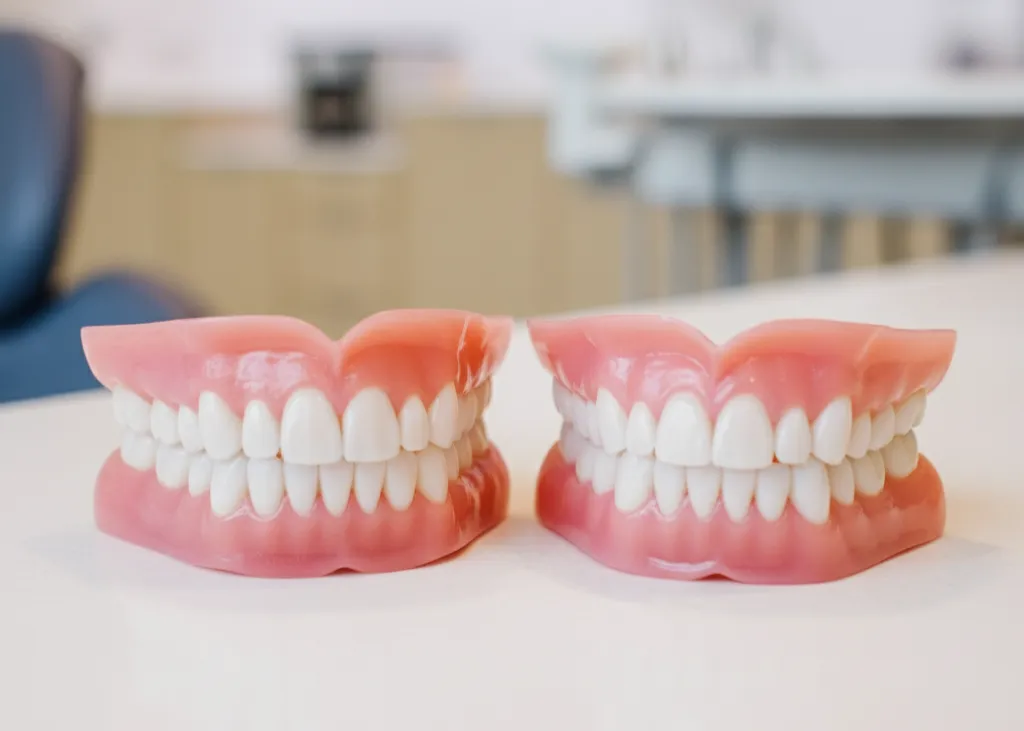
What Is a Dental Plate and How Much Does It Cost?
“Dental plate” is another name for a denture: the acrylic or metal base that holds the replacement teeth. Patients and dentists use both terms for the same thing.
Dental plate cost breaks down the same way as denture pricing above. A partial dental plate, replacing several teeth, runs $1,800 to $2,400. A full dental plate, replacing all upper or lower teeth, costs $2,275 to $3,500 per arch.
The cost depends on:
- Material. Acrylic plates cost less than metal-framework plates. Metal is thinner, stronger, and more comfortable for many patients.
- Number of teeth replaced. More teeth means more fabrication work.
- Customization. Shade matching, natural tooth positioning, and gum contouring add cost, and the difference in appearance is easy to see.
A search for “dental plate cost” turns up the same prices as “denture cost” because it is the same product.
What Affects the Cost of Dentures?
The same patient can be quoted $1,800 at one office and $3,500 at another for what sounds like the same denture. These are the variables that explain the gap.
Partial vs. Full Dentures
Partial dentures cost less because they replace fewer teeth and clip onto your remaining natural teeth for support. Full dentures replace an entire arch and take more material, more lab time, and more fitting appointments.
Material Quality
- Standard acrylic: $2,275 to $2,500 per arch. Functional and durable, with a standard base and teeth.
- Mid-range: $2,500 to $3,000 per arch. Better tooth quality, more realistic gum coloring, thinner base.
- Premium: $3,000 to $3,500+ per arch. Porcelain or composite teeth, detailed gum characterization, precision fit. These are the dentures that look most natural.
Extractions
If teeth have to come out before dentures, that is an added cost. Simple extractions are commonly quoted around $265 to $350 per tooth and surgical extractions around $380 to $600 per tooth. A full-mouth case can run $1,500 to $3,000 or more. Some practices fold extractions into a denture package, so ask at the consultation.
Immediate vs. Conventional Dentures
Conventional dentures are made after your gums heal from extractions, usually 6 to 8 weeks. They fit better from the start because your mouth has settled.
Immediate dentures go in the same day the teeth come out. You leave with teeth, and they cost $300 to $500 more because they need relines as your gums heal and shrink over the following months.
Number of Fitting Appointments
Good dentures take several fittings, usually 4 to 7 appointments over 4 to 6 weeks. A rushed process produces dentures that fit poorly, which means adjustments and relines you pay for later.
Geographic Location
Denture prices track local overhead. Downtown and high-rent neighborhoods charge more, inner-ring suburbs run about the same as the metro average, and rural offices charge less. Nashville sits mid-range nationally. Traveling for a cheaper denture also means traveling back for every adjustment and reline.
Does Insurance Cover Dentures in Nashville?
Most dental plans, in Tennessee and elsewhere, cover dentures as a prosthetic benefit. Here is what that looks like in practice.
Typical coverage: 40% to 50% of the cost, subject to your annual maximum.
Common limitations:
- Annual maximum of $1,000 to $2,500, which may cover a large portion of one arch
- Waiting periods of 6 to 12 months for major procedures
- One set of dentures per 5 to 8 years
- Pre-authorization on some plans
Usually covered:
- Complete dentures, upper, lower, or both
- Partial dentures
- Relines, often every 2 years
- Repairs
Often not covered:
- Implant-supported dentures, though some plans cover the denture and not the implants
- Cosmetic upgrades
- Replacement dentures before the frequency limit
How to Maximize Your Insurance Benefits
-
Get pre-authorization. Submit the treatment plan before starting so you know exactly what is covered.
-
Use your full annual maximum. If your plan year ends soon, starting now keeps costs inside the current benefit year.
-
Check medical insurance too. If teeth were lost to an accident or trauma, medical insurance may cover part of the work.
-
Use your HSA or FSA. Dentures qualify for pre-tax health dollars. In a 25% bracket, a $2,400 denture costs about $1,800 in real money.
Example: What You’d Actually Pay
- Full upper and lower dentures: $4,550 to $6,000
- Insurance covers 50% up to a $1,500 annual max: minus $1,500
- Out of pocket: $3,050 to $4,500
On a payment plan, that is roughly $255 to $375 a month over 12 months.
Financing Options for Dentures
Most plans pick up part of the cost and leave a real balance. A few ways patients cover the rest.
In-House Payment Plans
Many dental offices offer interest-free plans. Terms usually run 6 to 24 months at 0% for qualified patients, with down payments from $200 to $500.
Healthcare Credit (CareCredit, Sunbit, Proceed Finance)
Medical credit cards offer promotional financing, often 0% APR for 6 to 24 months if you pay the balance in full. Read the fine print, because deferred interest plans charge back-interest if you miss the payoff deadline. Nations Dental Studio partners with Sunbit. Most patients get approved in minutes and can see payment options before committing to anything.
HSA and FSA Accounts
Dentures qualify as a medical expense. Paying with pre-tax dollars saves 20% to 30% depending on your bracket. FSA funds expire annually, so if your plan year is ending, put those dollars toward the down payment or the full cost.
TennCare (Tennessee Medicaid)
TennCare covers dentures for eligible adults, though coverage varies by plan and may limit materials or frequency. Contact your TennCare plan directly to verify denture benefits. Other state Medicaid programs vary widely, and several cover no adult denture benefit at all.
Dentures vs. Alternatives: Cost Comparison
Dentures cost less upfront than any other multi-tooth replacement. Upfront cost is only part of the picture, because lifespan changes the math.
| Option | Upfront Cost (Full Arch) | Lifespan | 20-Year Cost |
|---|---|---|---|
| Full dentures | $2,275 - $3,500 | 5-8 years | $7,000 - $14,000 |
| Implant-supported dentures | $8,000 - $15,000 | 15-20 years | $8,000 - $15,000 |
| All-on-4 implants | $15,000 - $25,000 | 20+ years | $15,000 - $25,000 |
| Option | Upfront Cost (Per Tooth) | Lifespan | 20-Year Cost |
|---|---|---|---|
| Partial denture (3-5 teeth) | $1,800 - $2,400 | 5-7 years | $5,400 - $7,200 |
| Dental bridge (3-4 teeth) | $2,000 - $4,000 | 7-10 years | $4,000 - $12,000 |
| Individual implants (per tooth) | $5,000 - $5,500 | 25+ years | $5,000 - $5,500 |
When Dentures Make the Most Sense
- Budget is tight. Dentures replace several teeth for a fraction of what implants cost.
- You need teeth now. Immediate dentures give you teeth the same day, while implants need 3 to 6 months of healing.
- Bone loss is advanced. Dentures work regardless of bone density. Dental implants need adequate bone or a graft.
- Surgery is off the table. Health conditions, medications, or personal preference may rule out a surgical approach.
- You’re saving for implants. A denture works as a stepping stone while you plan for implant-supported options later.
When to Consider Alternatives
- You want something permanent. Implants last 25 years or more and feel close to natural teeth.
- You’re replacing 1 or 2 teeth. A bridge or a single implant is usually more practical than a partial denture.
- Bone preservation matters. Dentures do not stimulate the jawbone, and over years that bone loss reshapes the face. Implants prevent it.
What to Expect: The Denture Process
Knowing the steps helps you budget both time and money. Our dentures service page walks through the same appointments in more detail.
-
Consultation. An exam, a discussion of your goals, and a treatment plan with clear pricing. If extractions are needed, those get planned first.
-
Impressions. Molds of your mouth capture the exact contours the denture has to match.
-
Try-in. A wax-up lets you see and feel an approximation of the finished denture. Fit, bite, shade, and appearance all get checked, and you give feedback before final fabrication.
-
Delivery. The finished denture is fitted, adjusted, and polished, along with care instructions and tips for eating with it.
-
Follow-ups. Appointments at 1 week, 1 month, and 3 months. Adjustments are normal and expected. After 3 months you move to periodic relines every 1 to 2 years.
The full process takes 4 to 6 weeks. A denture that fits right from the start saves money on adjustments later, so it is worth the appointments.
How to Save Money on Dentures Without Cutting Corners
1. Don’t Skip Quality for Price
The cheapest dentures often cost more over time. A poor fit means more adjustments, more relines, and earlier replacement. Mid-range or better materials get you a denture that lasts 5 to 8 years with proper care.
2. Maximize Insurance
Patients leave insurance money on the table all the time. Verify your benefits, get pre-authorization, and time treatment to use your annual maximum.
3. Use Pre-Tax Dollars
HSA and FSA accounts cut your effective cost by 20% to 30%. A $2,400 denture costs about $1,800 in after-tax dollars.
4. Ask About Package Pricing
Some practices bundle extractions, dentures, and follow-up care into one price, which often costs less than paying for each service separately.
5. Maintain Your Dentures
Daily cleaning, proper storage, and regular check-ups prevent repairs and stretch the life of the denture. A $15 denture brush and cleaning solution saves hundreds in repair bills.
FAQs
How much do full dentures cost in Nashville?
$2,275 to $3,500 per arch, depending on materials and customization. Upper and lower together run $4,550 to $6,000. Insurance often covers 40% to 50% up to your annual maximum. At Nations Dental Studio, complete dentures are $2,275 to $2,440 per arch.
Are dental plates the same as dentures?
Yes. “Dental plate” is another name for a denture, the acrylic or metal base that holds the replacement teeth. Same product, same pricing.
How much does a partial denture cost?
$1,800 to $2,400 in most markets, depending on material: acrylic, metal framework, or flexible. A partial replaces several teeth and keeps your remaining natural ones in place. At Nations Dental Studio, partials are $1,800 to $2,360 per arch.
Does TennCare cover dentures?
TennCare, Tennessee’s Medicaid program, covers dentures for eligible adults, though the specifics vary by plan. Coverage typically includes basic dentures with limits on materials. Contact your TennCare plan to verify.
How long do dentures last?
5 to 8 years with proper care before they need replacement. Relines every 1 to 2 years keep the fit tight as your mouth changes. Better materials and regular maintenance push that number higher.
Can I get dentures the same day as extractions?
Yes, and those are called immediate dentures. They cost $300 to $500 more than conventional dentures and need relines as the gums heal. You walk out with teeth that day instead of waiting 6 to 8 weeks.
How do I make my dentures look natural?
It comes down to material quality, customization, and fit. Premium teeth, shade matching, and natural tooth positioning make a visible difference. Read our full guide: Most Natural Looking Dentures: 2026 Guide.
Are implant-supported dentures worth the extra cost?
They run $8,000 to $15,000 or more per arch, well above traditional dentures. They also stay put, chew better, and preserve jawbone. If the budget is there it is a real upgrade, and if it isn’t, traditional dentures still do the job well for a fraction of the price. Learn more about dental implant options.
Next Steps
A consultation for custom dentures in Nashville covers an exam, your options for partial, full, or implant-supported dentures, verified insurance benefits, and your exact price before any work starts.
Book your first visit online or call (615) 933-5800. You can also contact us with questions.